1. What is Coast FIRE? The Modern Paradigm Shift
For generations, personal finance doctrine preached a single, rigid path toward retirement: spend 40 consecutive years in a corporate or institutional career, continuously funnel 15% to 20% of every paycheck into retirement accounts, and cross your fingers that you reach your golden years with enough capital intact to survive.
The FIRE (Financial Independence, Retire Early) revolution challenged that dogmatic narrative by introducing aggressive savings rates (often 50% to 70%) to collapse the working timeline from four decades down to ten or fifteen years. Yet full Traditional FIRE carries its own psychological and physical burdens: extreme frugality, intense burnout, and the terror of walking away from income generation entirely in one's early thirties.
Coast FIRE represents the golden mean of modern wealth accumulation. It is defined as the exact milestone at which an investor has accumulated sufficient invested capital in their early working years that, without contributing a single additional dollar from that day forward, the mathematical engine of compound growth will organically carry their portfolio across their full retirement goal by traditional retirement age (typically age 60 to 65).
💡 The Core Philosophical Breakthrough of Coast FIRE
Once you reach your Coast FIRE number, you eliminate the single largest line item in your personal financial budget: retirement savings. You no longer need to save $1,000, $2,000, or $3,000 every month into your 401(k) or brokerage. Consequently, your annual income requirement plummets to your bare living expenses. You can step down from high-stress 70-hour corporate grinds to work 25 hours a week at a nonprofit, launch an independent consulting practice, freelance, or take prolonged sabbaticals with total peace of mind.
2. The Mathematical Formula & Equation Proof
Underneath the lifestyle flexibility of Coast FIRE lies an unyielding mathematical principle: the present discounted value of a future compounded annuity. To solve for your Coast FIRE number, we operate in two distinct steps:
Example: If you plan to spend $60,000 per year in retirement and follow the standard 4.0% rule (0.04), your target nest egg is $60,000 / 0.04 = $1,500,000.
Where r is your expected annual real rate of return (e.g. 0.07 for 7%) and t is the number of compounding years remaining (Retirement Age - Current Age).
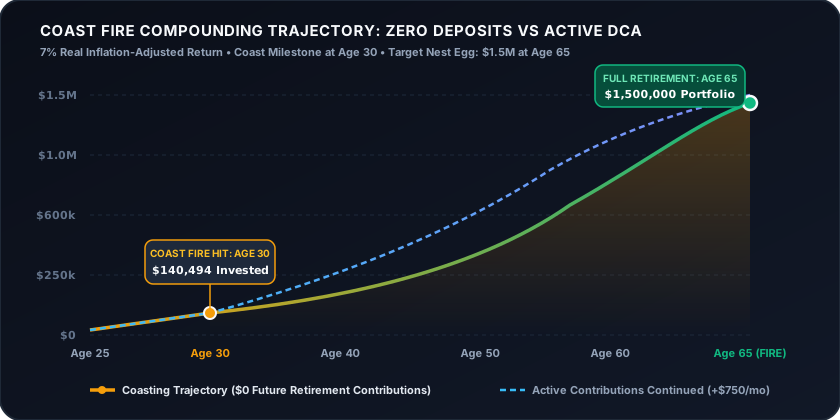
Let us examine the exponential leverage of time. Consider an investor aiming for a $1,500,000 portfolio at age 65 under an expected 7.0% real return:
| Starting Age | Years to Compound (t) | Compounding Multiplier ((1.07)^t) | Coast FIRE Number Needed |
|---|---|---|---|
| Age 22 | 43 Years | 18.67x | $80,342 |
| Age 25 | 40 Years | 14.97x | $100,170 |
| Age 30 | 35 Years | 10.68x | $140,494 |
| Age 35 | 30 Years | 7.61x | $197,049 |
| Age 40 | 25 Years | 5.43x | $276,380 |
| Age 50 | 15 Years | 2.76x | $543,674 |
Notice the profound non-linear asymmetric advantage of frontloading savings: an investor who accumulates just $80,342 by age 22 or $140,494 by age 30 achieves the exact same financial destination at age 65 as an investor who waits until age 50 and scrambles to amass over $543,000!
3. The Trinity Study & Safe Withdrawal Rates (SWR)
The benchmark anchor for calculating your Target Nest Egg is the Safe Withdrawal Rate (SWR). Originating from the seminal 1998 research paper authored by professors Philip L. Cooley, Carl M. Hubbard, and Daniel T. Walz at Trinity University (commonly celebrated as the Trinity Study), the safe withdrawal rate determines what percentage of your portfolio you can withdraw in Year 1 of retirement, adjusting subsequent annual withdrawals upward for inflation, without exhausting your capital across a 30-year horizon.
Assuming a diversified 75% equity / 25% bond allocation, the 4% rule demonstrated a 95% historical survival rate over traditional 30-year retirements. Under this rule, your Target Nest Egg equals exactly 25x your annual expenses ($60,000 × 25 = $1,500,000).
For early retirees anticipating a 40-to-50-year retirement span, sequence of returns risk increases. Modern researchers (such as Big ERN of EarlyRetirementNow) recommend calibrating your nest egg to a 3.5% SWR (28.6x expenses), which historically achieved a 100% survival rate across all Great Depression and 1970s stagflation eras.
4. The 4 FIRE Pillars: Coast vs Barista vs Lean vs Fat
The financial independence taxonomy has evolved far beyond all-or-nothing early retirement. Choosing the right FIRE strategy depends on how much active work you wish to perform and your desired annual living budget:
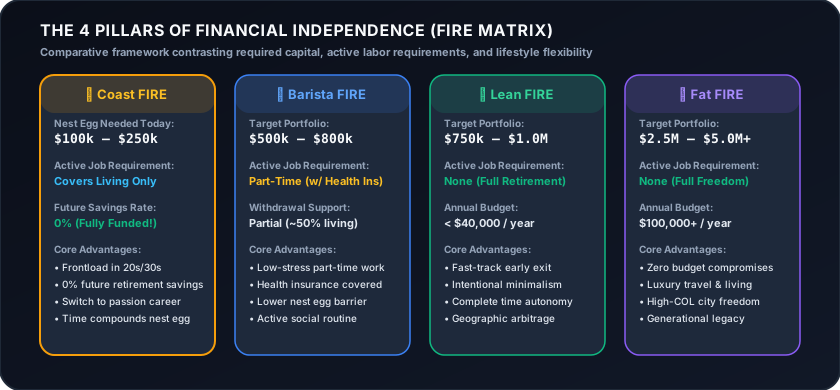
- Coast FIRE: You save aggressively early until your portfolio hits its self-compounding curve. You never withdraw from the portfolio until age 60-65. You work whatever job covers your current baseline bills.
- Barista FIRE: You accumulate a substantial nest egg ($500k-$800k) that partially subsidizes living costs. You work a lower-stress part-time job (often 20 hours/week at Starbucks, retail, or a local municipality) primarily to obtain health insurance and supplemental cash flow.
- Lean FIRE: Full complete retirement, but with an austere, highly minimalist lifestyle budget (typically under $40,000/year). Requires approximately $800k to $1.0M.
- Fat FIRE: Uncompromised luxury retirement. Supporting an annual lifestyle budget of $120,000 to $250,000+ per year without any active labor, requiring a massive $3.5M to $6M+ portfolio.
5. Real vs Nominal Returns & Inflation Realities
The most devastating mistake amateur financial planners make is confusing nominal returns with real returns. If you run a 30-year simulation assuming a 10% annual S&P 500 return without discounting for inflation, your future $1,500,000 balance may sound wealthy, but decades of cumulative 2.5% to 3.0% inflation will erode your actual purchasing power by more than half.
The HandyTallies Coast FIRE Engine resolves this by operating natively under the Fisher Equation:
By modeling our defaults at a conservative 7.0% Real Annual Return (reflecting the 100-year historical return of the broad U.S. stock market net of consumer price index inflation), all milestone targets generated by this calculator remain expressed in today's purchasing power. A $60,000 retirement budget calculated today represents precisely $60,000 worth of groceries, utilities, travel, and healthcare in future dollars.
6. 3 Concrete Real-World Personas & Case Studies
To visualize how Coast FIRE functions in everyday practice, review three diverse case studies:
Alex (Software Engineer)
- • Current Savings: $110,000
- • Target Retirement Age: 65
- • Target Budget: $55,000 / year
- • Coast Number Needed: $91,821
Elena & Mark (Teachers)
- • Combined Savings: $185,000
- • Target Retirement Age: 62
- • Target Budget: $70,000 / year
- • Coast Number Needed: $263,371
David (Healthcare Admin)
- • Current Savings: $340,000
- • Target Retirement Age: 65
- • Target Budget: $65,000 / year
- • Coast Number Needed: $342,750
7. Tax Optimization: Roth, 401(k) & Taxable Accounts
Where your Coast FIRE assets reside significantly impacts your flexibility:
1. Roth IRAs (The Ideal Coast Compounder): Because Roth IRA contributions grow 100% tax-free and withdrawals in retirement are entirely tax-exempt, your target nest egg does not need to be grossed up for income taxes. Furthermore, your principal contributions can be withdrawn penalty-free at any time if an unexpected cash flow emergency strikes during your coasting years.
2. Traditional 401(k) / Pre-Tax IRAs: Pre-tax retirement accounts are subject to ordinary income taxes upon distribution after age 59½. If your $1.5M nest egg sits entirely inside a pre-tax account, paying an effective 15% federal and state tax rate means your net spending capacity is only $51,000 rather than $60,000. Plan your SWR accordingly.
3. Taxable Brokerage Accounts (Bridge Accounts): Having a portion of your Coast portfolio in a regular brokerage account holding tax-efficient index funds or qualified dividend ETFs (such as SCHD) allows you to harvest preferential long-term capital gains tax rates (0% or 15% for most filers) and provides complete liquidity without IRS early-withdrawal penalty rules.
8. Critical Risks: Sequence of Returns & Healthcare
Before you submit your resignation letter or declare yourself officially "coasting", consider two essential risk mitigations:
Sequence of Returns Risk (SRR)
While Coast FIRE minimizes SRR because you are not selling assets to pay living expenses, a prolonged 5-year bear market immediately after you stop contributing can stall your trajectory. Maintaining a 6-month liquid emergency fund and possessing the flexibility to freelance or pick up extra shifts during economic contractions acts as an indispensable shock absorber.
U.S. Healthcare & Health Insurance
In the United States, employer-sponsored healthcare is often the golden handcuff. Coasting professionals must account for health insurance costs, whether through the Affordable Care Act (ACA) marketplace (where lower earned income often unlocks substantial premium tax credits) or through part-time employment that extends healthcare benefits.
9. The Psychology of Coasting & Career Freedom
Perhaps the most difficult barrier to Coast FIRE is not mathematical—it is emotional. High-achieving accumulators frequently suffer from "One-More-Year Syndrome": the compulsion to keep grinding for corporate promotions and stacking capital long after their mathematical security has been guaranteed.
Money is ultimately an instrument to purchase sovereignty over your finite hours on earth. Achieving Coast FIRE allows you to experience the physical and mental benefits of retirement in your 20s, 30s, and 40s—when your health, energy, and family presence are at their absolute peak—rather than waiting for a frail, uncertain retirement at age 68.
10. Frequently Asked Questions (FAQ)
Authoritative answers to common questions regarding Coast FIRE math, Safe Withdrawal Rates, and early career transitions.
What is Coast FIRE and how does it differ from traditional retirement?
Coast FIRE is the financial milestone where your existing investment portfolio is large enough that compound interest alone will grow it to your target retirement nest egg by your target retirement age, without saving another dollar. Unlike Traditional FIRE where you must accumulate your full multi-million-dollar nest egg before stopping work, Coast FIRE allows you to stop saving in your 20s or 30s. You only need to earn enough from active work to cover your day-to-day living expenses.
How is the Coast FIRE number calculated mathematically?
The Coast FIRE formula is Coast FIRE = Target Nest Egg / (1 + r)^t. First, you calculate your Target Nest Egg by dividing your anticipated annual retirement expenses by your Safe Withdrawal Rate (e.g., $60,000 / 0.04 = $1,500,000). Second, you discount that nest egg back to today using your expected real annual return (r, typically 7% for equities) and the number of compounding years remaining until retirement (t = Retirement Age - Current Age).
What real rate of return should I assume for Coast FIRE calculations?
Most financial planners and academic FIRE literature recommend assuming a 6.0% to 7.0% real (inflation-adjusted) return for a diversified broad-market equity portfolio (such as total U.S. stock market index funds or S&P 500 ETFs). While the historical nominal return of the S&P 500 is approximately 10% before inflation, subtracting historical inflation of ~3% yields the standard 7% real compounding baseline.
What is the difference between Coast FIRE and Barista FIRE?
Under Coast FIRE, your investments grow untouched for decades until traditional retirement age (e.g., 60-65), while you earn 100% of your current living expenses through low-stress or passion work without saving. Under Barista FIRE, your portfolio is already partially supporting you; you withdraw a small annual percentage (e.g. 2%) and work a part-time job specifically to cover the remaining spending gap and secure employer healthcare benefits.
Does Coast FIRE account for inflation?
Yes. By running the compounding simulation using real (inflation-adjusted) growth rates rather than nominal rates, all calculations—including your annual spending target, future nest egg, and current Coast number—remain expressed in today's constant purchasing power. This prevents the distortion caused by compounding inflation over multi-decade horizons.
What happens if the stock market experiences a major downturn right after I start coasting?
This is known as Sequence of Returns Risk (SRR). Because Coast FIRE participants do not withdraw from their portfolio during their coasting years (they earn active income for living expenses), market downturns actually offer an advantage: you avoid selling shares at a loss, and if you choose to invest even modest surplus amounts, you purchase equities at discounted valuations.
Can I include home equity in my Coast FIRE savings calculation?
Generally no, unless you plan to sell or downsize your primary residence upon retirement to convert home equity into income-generating liquid assets. Your primary home does not produce passive cash flow to sustain retirement expenses; only liquid, investable assets (index funds, ETFs, dividend portfolios, retirement accounts) should be counted in your Coast FIRE number.
How does Social Security impact my Coast FIRE milestone?
Social Security benefits provide a government-guaranteed, inflation-adjusted income floor in your late 60s. Factoring in Social Security reduces your required annual withdrawal from your private portfolio. For example, if your living expenses are $60,000 and Social Security pays $24,000, your portfolio only needs to fund $36,000 annually, dropping your Target Nest Egg from $1.5M to $900,000 and dramatically lowering your Coast FIRE number.
What safe withdrawal rate (SWR) is safest for early retirees?
The famous Trinity Study established that a 4.0% safe withdrawal rate historically survived 95% of 30-year retirement windows. However, for retirees planning a 40-to-50-year horizon, financial researchers (such as Big ERN and Michael Kitces) recommend a more conservative SWR between 3.25% and 3.5% to virtually eliminate failure risks across all historical market eras.
Does HandyTallies store or log my financial information when I use this tool?
No. HandyTallies executes 100% of calculation mathematics directly inside your browser's local JavaScript runtime. Your salary, current net worth, retirement goals, and CSV exports are never transmitted to, tracked by, or stored on external web servers or databases.
Explore More Free Financial Tools
Discover our growing suite of dividend, cash flow, and investment calculators.
SCHD Dividend Calculator
Simulate monthly DRIP dividend compounding, future share price appreciation, and total cash flow for Schwab U.S. Dividend Equity ETF.
Dividend Snowball Calculator
Simulate the exponential dividend snowball effect, crossover tipping point, and hands-free monthly passive income stream.
Snow Day Calculator
Estimate the odds your school closes tomorrow based on snowfall, ice accumulation, and bus safety protocols.