1. What is a Certificate of Deposit (CD) and How Does it Work?
A Certificate of Deposit (CD) is a specialized promissory agreement between a depositor and a regulated financial institution (such as a commercial bank, savings association, or credit union). When you purchase a CD, you deposit a specified sum of capital for a strictly defined maturity duration—ranging from as short as 1 month to as long as 10 years.
In return for locking your liquidity with the bank, the financial institution guarantees a legally enforceable, fixed interest rate known as the Annual Percentage Yield (APY). Unlike traditional savings accounts where interest rates fluctuate daily based on decisions by the Federal Open Market Committee (FOMC), a CD locks your rate in cement. Even if the Federal Reserve cuts the federal funds rate by 200 basis points tomorrow, your CD rate remains untouchable until the day it matures.
The Three Core Pillars of a CD Contract:
- Principal: The initial lump-sum deposit invested (protected up to $250,000 by FDIC insurance).
- Term Duration: The fixed timeframe before funds mature (typically 3, 6, 12, 18, 24, 36, or 60 months).
- Guaranteed APY: The compounding rate of return earned on principal across the entire life of the deposit.
2. CD vs. High-Yield Savings Account (HYSA): Rate Lock vs. Liquidity
Savers frequently debate whether they should place surplus cash into a High-Yield Savings Account (HYSA) or lock it into a Certificate of Deposit. The answer comes down to a trade-off between reinvestment interest rate risk and liquidity flexibility.
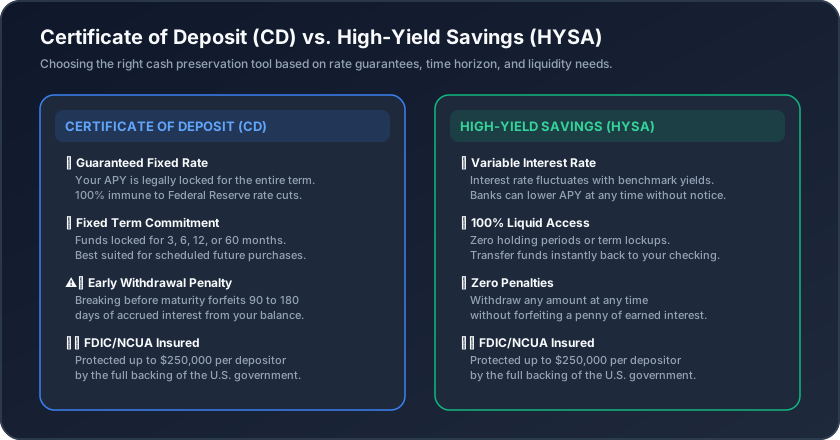
If you believe interest rates will decline over the next 12 to 24 months, locking in a 4.75% or 5.00% CD is an advantageous financial maneuver. When the Fed cuts rates and HYSA accounts drop to 3.00% or 2.50%, your locked CD continues generating 5.00% every single month until maturity. However, if you may need that money tomorrow for unexpected emergencies, an HYSA or our dedicated Emergency Fund Calculator provides the liquidity you require.
3. APY vs. APR: Decoding Compound Interest Math & Regulation DD
Under Federal Reserve Regulation DD (12 CFR Part 1030), all depository institutions in the United States are legally required to disclose their Annual Percentage Yield (APY) alongside the nominal Annual Percentage Rate (APR). Why does this distinction matter? Because compounding frequency changes the amount of money in your pocket.
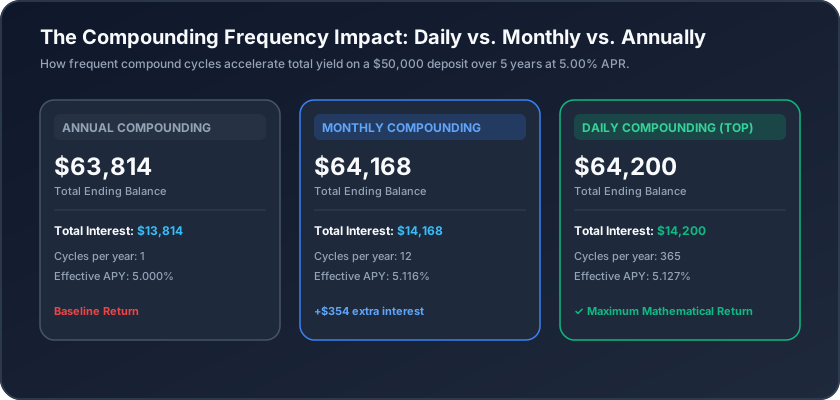
The mathematical formula governing your final CD balance is:
Where P is your initial principal, r is the nominal annual percentage rate, n is the compounding periods per year (365 for daily, 12 for monthly), and t is the duration in years. Because daily compounding calculates interest on previously earned pennies every 24 hours, top online banks that compound daily generate slightly more cash for depositors than institutions compounding only once per quarter or once per year.
4. The 4-Rung CD Ladder Strategy: Unlocking Perpetual Liquidity
The primary psychological hesitation people experience when purchasing CDs is fear of commitment: "What if I need that $20,000 in 6 months?" The solution developed by financial planners is the Rolling CD Ladder.
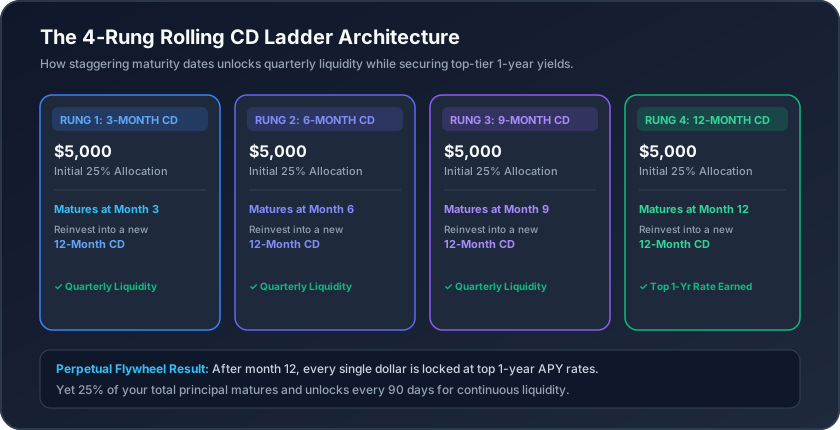
Instead of placing $20,000 into a single 1-year CD, you split the capital into four $5,000 slices:
- Rung 1: $5,000 in a 3-Month CD
- Rung 2: $5,000 in a 6-Month CD
- Rung 3: $5,000 in a 9-Month CD
- Rung 4: $5,000 in a 12-Month CD
Every 90 days, one of your CDs matures! When Rung 1 matures at Month 3, you can either take that $5,000 out penalty-free to pay for a vacation or car repair, or roll it into a new 1-year CD. By Month 12, every single dollar of your $20,000 portfolio is earning peak 12-month interest rates, yet you have cash maturing and becoming accessible every single quarter!
5. Early Withdrawal Penalty Clauses: How Banks Calculate Clawbacks
What happens if you have an urgent medical crisis or job loss and must break your CD before the maturity date? The bank will not refuse your withdrawal request, but they will enforce an Early Withdrawal Penalty (EWP).
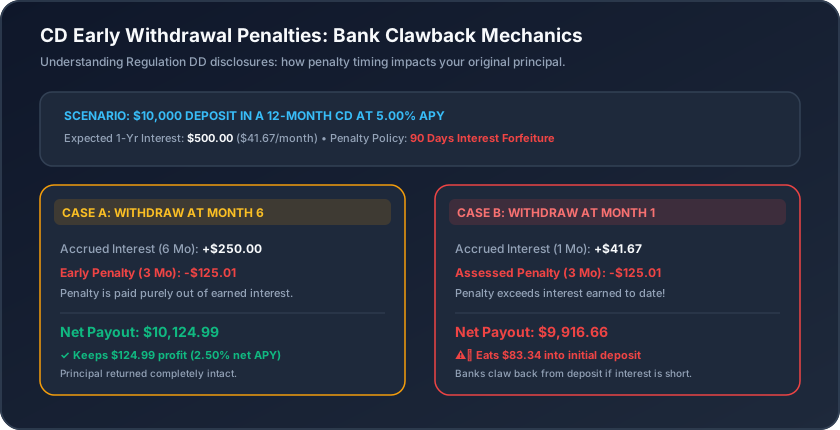
Under standard banking terms, early withdrawal penalties are assessed as a fixed number of days of interest:
Equal to 3 months of accrued interest forfeited.
Equal to 6 months of accrued interest forfeited.
Equal to 9 to 12 months of accrued interest forfeited.
The Principal Protection Warning: If you withdraw from a 12-month CD after holding it for only 30 days, your accrued interest is only 1 month ($41.67). However, the bank penalty is 3 months ($125.01). The bank claws back the full $125.01, deducting the remaining $83.34 straight from your original deposit principal!
6. CD Types Explained: Fixed, Bump-Up, No-Penalty, Brokered, and Jumbo CDs
Beyond traditional fixed-rate certificates, modern commercial financial institutions provide several specialized CD variations designed for different investor goals:
1. Traditional Fixed-Rate CD
The standard vehicle modeled in our calculator above. Fixed term, fixed rate, predictable ending balance, standard early withdrawal penalty.
2. No-Penalty (Liquid) CD
Allows depositors to break the CD and withdraw full principal and all accrued interest penalty-free after an initial 6-day seasoning period. Because of this flexibility, starting APYs are typically 0.25% to 0.50% lower than traditional CDs.
3. Bump-Up / Step-Up CD
Grants you a one-time (or two-time) contractual option to request that the bank increase your CD's APY to match new market rates if benchmark interest rates rise during your term.
4. Brokered CDs (Fidelity, Schwab, Vanguard)
Purchased inside a brokerage account from third-party banks nationwide. Brokered CDs do not have standard bank withdrawal penalties; if you need your money early, you sell the certificate on the secondary bond market at prevailing market prices.
5. Jumbo CDs
Certificates requiring large minimum deposits ($100,000 or more). Traditionally offered premium yields, though in modern online banking, retail CDs often match or exceed jumbo rates.
7. Tax Implications: Form 1099-INT and Phantom Income Rules
One unexpected surprise for beginner savers is phantom income taxation on multi-year certificates of deposit. If you buy a 5-year CD that matures in 2031 and choose to let the interest compound inside the certificate rather than receiving monthly payouts, you might assume you owe no taxes until 2031.
Under IRS tax regulations, interest on CDs is taxable in the calendar year in which it is credited to your account, not the year the certificate matures. Every January, your bank will send you a Form 1099-INT reporting all interest credited during the prior calendar year. That interest is taxed at your ordinary income tax rate.
8. Frequently Asked Questions (FAQ)
Authoritative answers to common questions regarding Certificate of Deposit yields, maturity options, and laddering mechanics.
How does a Certificate of Deposit (CD) work?
A Certificate of Deposit is a federally insured time deposit where you agree to lend a fixed sum of money to a bank or credit union for a predetermined period (e.g., 6 months, 1 year, 5 years). In exchange, the institution guarantees a fixed Annual Percentage Yield (APY) that will not fluctuate, regardless of changes in benchmark Federal Reserve rates.
What is the difference between APR and APY on a CD?
Annual Percentage Rate (APR) represents the simple, nominal interest rate without taking compounding into account. Annual Percentage Yield (APY) reflects the true annual rate of return including the effect of compound interest throughout the year. Because interest compounds daily or monthly, APY is always slightly higher than APR.
What happens if I withdraw money from a CD before the maturity date?
If you break a CD before its scheduled maturity date, the bank assesses an Early Withdrawal Penalty. Under federal Regulation DD disclosures, this penalty is typically equal to a set number of months of interest (such as 90 days for terms under 1 year, and 180 to 365 days for multi-year terms). If you withdraw very early, the penalty can exceed earned interest and reduce your original principal.
What is a CD Ladder and how does it work?
A CD ladder is an investment strategy where you divide your total cash deposit equally across multiple certificates with staggered maturity dates (e.g., 3-month, 6-month, 9-month, and 12-month CDs). As each CD matures every quarter, you either access the cash penalty-free or reinvest it into a new 12-month CD at peak interest rates, creating a rolling cycle of liquidity.
Are CD earnings taxable?
Yes. Interest earned on bank certificates of deposit is considered ordinary income and is taxable at your federal and state tax brackets in the year it accrues, even if you choose to reinvest the interest back into the CD rather than withdrawing it. Banks issue Form 1099-INT annually for interest totaling $10 or more.
Are CDs safe? What happens if the bank fails?
CDs issued by FDIC-insured banks or NCUA-insured credit unions are among the safest financial instruments in the world. Deposits are backed by the full faith and credit of the United States Government up to $250,000 per depositor, per insured bank, for each account ownership category.
Explore More Free Financial Tools
Discover our growing suite of dividend, cash flow, and investment calculators.
SCHD Dividend Calculator
Simulate monthly DRIP dividend compounding, future share price appreciation, and total cash flow for Schwab U.S. Dividend Equity ETF.
JEPI Dividend Calculator
Simulate monthly covered-call cash flow, option premium payouts, and DRIP compounding for JPMorgan Equity Premium Income ETF.
JEPQ Dividend Calculator
Calculate Nasdaq-100 covered-call dividend distributions, monthly DRIP compounding, and volatility cash flow for JEPQ ETF.
VOO Dividend Calculator
Project long-term S&P 500 compounding, quarterly dividend reinvestment, and multi-decade wealth accumulation for Vanguard S&P 500 ETF.
VYM Dividend Calculator
Forecast quarterly dividend income and DRIP compounding for Vanguard High Dividend Yield ETF across 450+ value equities.
DGRO Dividend Calculator
Simulate dividend growth, payout-ratio screened reinvestment, and long-term compounding for iShares Core Dividend Growth ETF.
VIG Dividend Calculator
Project compounding returns, 10+ year dividend streak accumulation, and quarterly payouts for Vanguard Dividend Appreciation ETF.
Coast FIRE Calculator
Calculate your exact Coast FIRE number, age milestone, and retirement nest egg without needing to save another dollar.
Dividend Snowball Calculator
Simulate the exponential dividend snowball effect, crossover tipping point, and hands-free monthly passive income stream.
Stock Average Down Calculator
Calculate new weighted average cost basis, break-even share price, and shares required to average down across multiple purchase lots.
Time and a Half Calculator
Calculate your time and a half 1.5x overtime hourly rate, double-time holiday pay, and total gross paycheck compensation.
Rule of 72 Calculator
Calculate how many years it takes for your money to double at any rate of return, and explore exponential compounding milestones.
Pay Raise Calculator
Calculate your new salary, hourly wage, and pay increase percentage across annual, monthly, and biweekly paychecks.
Barista FIRE Calculator
Calculate your Barista FIRE number, required part-time income, and milestone timeline to escape the corporate grind early.
Snow Day Calculator
Estimate the odds your school closes tomorrow based on snowfall, ice accumulation, and bus safety protocols.
Emergency Fund Calculator
Calculate your personalized 3 to 12 month survival safety net, funding gap, and annual high-yield savings interest yield.
Inflation Calculator
Calculate purchasing power erosion, historical BLS CPI price changes (1950–2026), and future cost-of-living retirement escalators.
Methodology
How we calculate this
The CD calculator grows your deposit at the APY you enter and estimates an early-withdrawal penalty.
Formulas used
- Ending balance
- deposit × (1 + APY)^(months ÷ 12)
- Nominal APR from APY
- APR = n × ((1 + APY)^(1/n) − 1), n = compounding periods per year
- Early-withdrawal penalty
- min(total interest, deposit × APR ÷ 12 × penalty months)
Step by step
- Because APY already includes compounding, the ending balance uses APY directly.
- APR is derived from APY for reference and for the penalty estimate.
- A monthly schedule shows the balance after each month.
Assumptions and limits
- The rate is fixed for the full term.
- Bank penalty rules vary; check your CD’s disclosure.
- Interest is shown before tax.
- The 4-rung ladder comparison uses an illustrative rate curve (APY minus 0.15 points per month shorter than 12), not live bank rates.
Worked example
Computed with the same code the calculator uses. Hypothetical example inputs, not a current bank rate.
| Deposit | $10,000 |
|---|---|
| Term | 12 months |
| APY | 4.00% |
| Compounding | daily |
| Penalty | 3 months of interest |
| Ending balance | $10,400.00 |
|---|---|
| Interest earned | $400.00 |
| Equivalent APR | 3.922% |
| Early-withdrawal penalty | $98.06 |
Related guides
- How Accurate Is the Rule of 72? Exact Doubling Times Compared min read
- APY vs APR: The Difference, With Conversion Formulas min read
- How Much Emergency Fund Do You Need? A Practical Formula min read
- How a CD Ladder Works: Building One Rung by Rung min read
- CD Early Withdrawal Penalties: How They Are Calculated min read
- Compound Interest Explained: The Formula and Why Time Wins min read
