1. The Anatomy of an Emergency Fund: Why Cash is King Before Compounding
In the era of viral financial independence, algorithmic stock trading, and high-yield dividend compounding, holding significant balances in cold, liquid cash is frequently dismissed as inefficient. Financial influencers often argue that holding $20,000 or $40,000 in a savings account creates "cash drag"—sacrificing long-term equity market gains of 8% to 10% annually.
However, financial history and empirical market data reveal an undeniable truth: an emergency fund is not an investment; it is an insurance policy with a guaranteed return of peace of mind. An emergency fund acts as an unbreachable moat surrounding your investment castle. Without liquid cash reserves, the moment an economic recession strikes, your transmission fails, or an unexpected medical deductible arrives, you are forced into one of two catastrophic financial moves:
Swiping a credit card at 24% to 29% APR to cover a $4,000 plumbing disaster. Paying only minimums on credit cards creates a compounding interest debt spiral that can take over 12 years to eliminate, destroying your monthly cash flow.
By establishing a fully funded safety net, you protect your long-term compounding machines from being dismantled by short-term life volatility. Cash buys you autonomy, negotiations leverage, and uninterrupted psychological tranquility.
2. The Duration Decision Matrix: 3, 6, 9, or 12 Months Runway?
The universal rule of thumb—"save 3 to 6 months of expenses"—is dangerously oversimplified. A tenure-track college professor with guaranteed employment and no dependents requires a vastly different cash safety net than a commissioned real estate broker or freelance software engineer supporting a spouse and three young children.
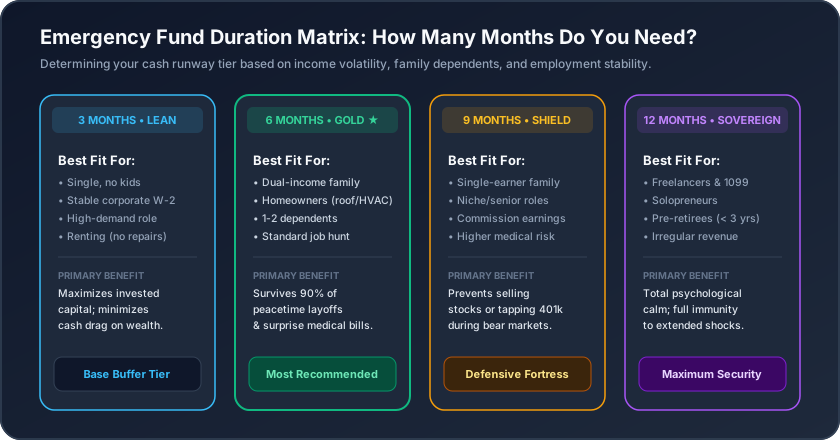
Evaluating Your Personal Risk Tier:
- 3 Months (The Lean Tier): Ideal for dual-income households with no children, both working in resilient, high-demand sectors (e.g., healthcare, government, public education). Renters with low fixed liabilities and family support networks can safely operate within this lean corridor.
- 6 Months (The Core Standard): The gold standard for typical homeowners and single-income W-2 earners with children. Owning real estate introduces inevitable lumpy expenses (HVAC replacements, roof leaks, plumbing backups) that standard renters avoid.
- 9 Months (The High-Responsibility Tier): Essential for single earners with multiple dependents, homeowners with older properties, or executives whose specialized positions require extended 6 to 9-month job searches following corporate restructuring.
- 12 Months (The Entrepreneur & Freelancer Fortress): Mandatory for 1099 contractors, commission-only sales reps, small business founders, or individuals planning early semi-retirement transitions like Barista FIRE or Coast FIRE. Volatile revenue requires an ironclad cash reserve.
3. Essential vs. Discretionary Survival Budgeting (The 50/30/20 Shift)
The most widespread mistake people make when calculating their emergency fund is multiplying their entire monthly paycheck by six. If your household takes home $7,000 monthly, you might assume you need a daunting $42,000 in cash. This calculation paralyzes savers and delays investment compounding by years.
In reality, your emergency fund is built exclusively around your bare-bones survival budget—the absolute non-negotiables required to keep a roof over your head, food on the table, utilities running, and healthcare intact during a catastrophic layoff.
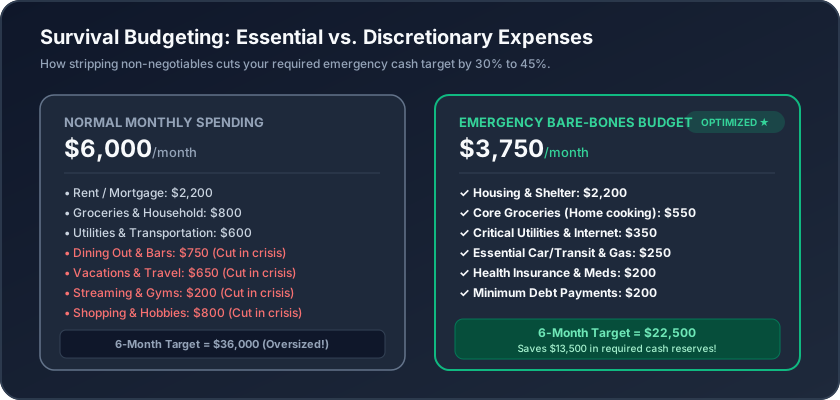
Notice what vanishes during an actual emergency: restaurant dining, coffee subscriptions, gym memberships, flights, concerts, and streaming bundles. By categorizing your expenses cleanly across the 7 survival categories in our calculator above (Housing, Groceries, Utilities, Transportation, Healthcare, Insurance, and Minimum Debt Obligations), a family that normally spends $7,000/month often discovers their true survival expense is just $4,200/month. A 6-month buffer drops from $42,000 down to $25,200—saving $16,800 of unnecessary cash hoarding!
4. Where to Park Your Emergency Reserves: HYSA vs. MMF vs. T-Bills vs. CDs
Never leave your emergency fund languishing in a traditional brick-and-mortar checking account paying 0.01% APY. At 0.01%, a $30,000 emergency fund generates a pitiful $3.00 per year while losing hundreds of dollars in purchasing power to inflation. However, you must also avoid locking emergency cash into volatile or illiquid assets.
| Vehicle Type | Typical APY | Liquidity Speed | Insurance / Guarantee | Suitability For Emergency Fund |
|---|---|---|---|---|
| High-Yield Savings (HYSA) | 4.00% – 5.00% | Instant to 24-48 Hours | FDIC / NCUA ($250k) | Ideal (Primary) |
| Money Market Funds (MMF) | 4.20% – 5.15% | T+1 Settlement | SIPC (Backed by U.S. Treasuries) | Excellent (Secondary) |
| 4-Week Treasury Bills | 4.30% – 5.25% | Held to maturity or secondary sale | Full Faith & Credit of U.S. Gov | Good (State-Tax Exempt) |
| Certificates of Deposit (CD) | 4.00% – 4.75% | Locked (Early withdrawal penalties) | FDIC / NCUA ($250k) | Tier 2 Buffer Only (CD Ladder) |
| Dividend ETFs (SCHD / VOO) | Volatile (-30% to +20%) | T+1 Settlement | Zero (Market Principal at Risk) | Unacceptable For Emergencies |
The winning architecture used by experienced financial planners is a two-tier cash buffer: keep 1 to 2 months of living expenses in an FDIC-insured High-Yield Savings Account linked directly to your primary checking account for instant transfers, and park months 3 through 6 in a government-backed Treasury Money Market Fund or 4-week Treasury Bill ladder for maximum yield and state income tax exemption.
5. Beating Inflation & Cash Drag: The 4.5% APY Advantage
When interest rates hovered near zero during the 2010s, holding cash was painful. Today, thanks to modernized benchmark rates, holding $25,000 in cash generates meaningful, passive monthly income that offsets the impact of inflation.
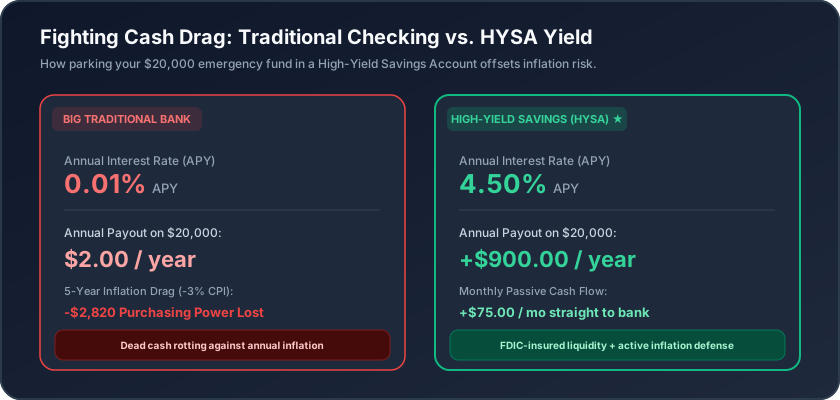
As demonstrated in the chart above, parking your $20,000 emergency fund in a modern 4.50% APY account produces $900 in gross annual interest—or roughly $75 every single month. That interest alone is enough to cover your monthly home internet bill, cell phone bill, or a full tank of gasoline without touching your principal balance!
6. Step-by-Step Accumulation Roadmap: From $1,000 Buffer to Fully Funded
Accumulating $15,000 to $30,000 can feel intimidating if you are currently starting from scratch. Trying to achieve a full 6-month fund overnight often leads to burnout and abandoned budgets. Instead, follow this proven four-phase milestone ladder:
Phase 1: The $1,000 Starter Shock-Absorber (Weeks 1 to 4)
Your primary objective is stopping the bleeding. A $1,000 starter buffer absorbs everyday minor surprises—a flat tire, a minor urgent care visit, or a broken appliance—preventing you from turning to high-interest credit cards.
Phase 2: One Full Month of Survival Expenses (Months 2 to 3)
Expand your reserves until you have exactly one full month of non-negotiable expenses (rent/mortgage, groceries, and utilities). This breaks the vicious paycheck-to-paycheck cycle and allows you to budget this month’s living costs using last month’s income.
Phase 3: The 3-Month Fortress & High-Interest Debt Intercept (Months 4 to 8)
Reach a solid 3-month survival fund. Once you reach 3 months, if you carry credit card balances at 20%+ APR, pause cash savings and direct 100% of your free cash flow toward annihilating that toxic debt before continuing.
Phase 4: Fully Funded 6 to 12-Month Autonomy (Months 9+)
Automate monthly transfers until your personalized target is met. Once fully funded, celebrate and redirect that entire monthly savings capacity into long-term wealth engines: retirement accounts, index funds, and dividend compounding tools like our Dividend Snowball Calculator.
7. The 3-Question Decision Rule: When to Tap vs. Protect Your Reserves
Building an emergency fund is only half the battle; defending it against lifestyle creep is just as crucial. When an unexpected expense arises, emotional stress can cloud your judgment. To prevent draining your safety net for non-emergencies, run every expense through our three-question decision rule:
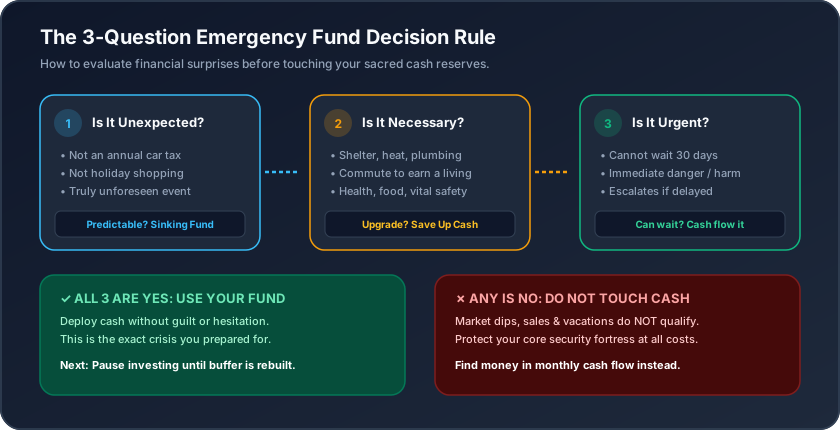
What Happens After You Spend From Your Emergency Fund?
If you encounter a genuine emergency and withdraw $3,000, do not panic or feel guilty—that is exactly why you built the fund! However, your immediate next action step is clear: pause all non-essential investments, discretionary spending, and extra debt paydowns until your emergency fund is replenished back to its required target.
8. Frequently Asked Questions (FAQ)
Authoritative answers to common questions regarding emergency fund planning, interest yields, and liquidity management.
How much money should I keep in an emergency fund?
Most financial planners and certified fiduciary advisers recommend holding 3 to 6 months of essential living expenses. Dual-income corporate employees with steady W-2 salaries and no dependents generally do well with 3 months. Single earners, homeowners with variable maintenance, families with children, or freelancers with volatile revenues should target 6 to 12 months of survival expenses.
Should I calculate my emergency fund using gross income or essential expenses?
Always base your emergency fund on essential monthly living expenses (bare-bones survival budget), never your gross income or total lifestyle budget. During a true financial crisis (e.g., job loss or disability), you immediately eliminate discretionary spending such as restaurant meals, luxury travel, subscriptions, and non-essential shopping.
Where is the best place to keep an emergency fund in 2026?
Your emergency fund should be held in an FDIC-insured High-Yield Savings Account (HYSA), an NCUA-insured high-yield credit union share account, or a government Money Market Fund (such as Vanguard VMFXX or Schwab SWVXX). These vehicles offer liquidity within 24 to 48 hours, guarantee principal safety up to federal limits, and currently pay competitive yields between 4.0% and 5.0% APY.
Should I invest my emergency fund in index funds or dividend ETFs like SCHD or VOO?
No. An emergency fund is risk insurance, not an investment engine. If a severe economic recession occurs, stock market downturns often coincide with corporate layoffs. If your emergency reserves are invested in equities, you could be forced to liquidate shares at a 30% to 50% loss right when you need the cash most.
Should I pay off high-interest credit card debt before building a full 6-month emergency fund?
Follow a tiered approach: first, establish a starter emergency fund of $1,000 to $2,500 (or one full month of basic rent and food) to avoid adding new debt when minor surprises occur. Next, aggressively direct all surplus cash toward paying off toxic debt with interest rates above 10%. Once toxic credit card debt is eliminated, return to building your full 3 to 6-month emergency cushion.
What qualifies as a genuine financial emergency?
A valid emergency satisfies three criteria: it is unexpected (not a planned annual expense like car insurance), urgent (cannot be safely delayed without severe penalty or health risk), and necessary (essential for shelter, basic food, medical health, or maintaining your ability to earn a living). Buying holiday gifts or upgrading home electronics are never emergencies.
Explore More Free Financial Tools
Discover our growing suite of dividend, cash flow, and investment calculators.
SCHD Dividend Calculator
Simulate monthly DRIP dividend compounding, future share price appreciation, and total cash flow for Schwab U.S. Dividend Equity ETF.
JEPI Dividend Calculator
Simulate monthly covered-call cash flow, option premium payouts, and DRIP compounding for JPMorgan Equity Premium Income ETF.
JEPQ Dividend Calculator
Calculate Nasdaq-100 covered-call dividend distributions, monthly DRIP compounding, and volatility cash flow for JEPQ ETF.
VOO Dividend Calculator
Project long-term S&P 500 compounding, quarterly dividend reinvestment, and multi-decade wealth accumulation for Vanguard S&P 500 ETF.
VYM Dividend Calculator
Forecast quarterly dividend income and DRIP compounding for Vanguard High Dividend Yield ETF across 450+ value equities.
DGRO Dividend Calculator
Simulate dividend growth, payout-ratio screened reinvestment, and long-term compounding for iShares Core Dividend Growth ETF.
VIG Dividend Calculator
Project compounding returns, 10+ year dividend streak accumulation, and quarterly payouts for Vanguard Dividend Appreciation ETF.
Coast FIRE Calculator
Calculate your exact Coast FIRE number, age milestone, and retirement nest egg without needing to save another dollar.
Dividend Snowball Calculator
Simulate the exponential dividend snowball effect, crossover tipping point, and hands-free monthly passive income stream.
Stock Average Down Calculator
Calculate new weighted average cost basis, break-even share price, and shares required to average down across multiple purchase lots.
Time and a Half Calculator
Calculate your time and a half 1.5x overtime hourly rate, double-time holiday pay, and total gross paycheck compensation.
Rule of 72 Calculator
Calculate how many years it takes for your money to double at any rate of return, and explore exponential compounding milestones.
Pay Raise Calculator
Calculate your new salary, hourly wage, and pay increase percentage across annual, monthly, and biweekly paychecks.
Barista FIRE Calculator
Calculate your Barista FIRE number, required part-time income, and milestone timeline to escape the corporate grind early.
Snow Day Calculator
Estimate the odds your school closes tomorrow based on snowfall, ice accumulation, and bus safety protocols.
CD Calculator
Calculate Certificate of Deposit interest payouts, maturity values, APY compounding, and rolling 4-rung CD ladder strategies.
Inflation Calculator
Calculate purchasing power erosion, historical BLS CPI price changes (1950–2026), and future cost-of-living retirement escalators.
Methodology
How we calculate this
The emergency fund calculator adds up essential monthly costs and multiplies by the number of months of coverage you choose.
Formulas used
- Monthly essentials
- housing + groceries + utilities + transportation + healthcare + debt minimums + other
- Target fund
- monthly essentials × months of coverage
- Months to fund
- ceil((target − current savings) ÷ monthly savings)
- Savings interest
- target × APY (annual, simple estimate)
Step by step
- Sum your essential expenses.
- Multiply by your coverage target.
- Subtract what you have saved and divide the gap by what you can save each month, rounding up.
Assumptions and limits
- Months-to-fund ignores interest earned while saving, so it is slightly conservative.
- Interest is a one-year simple estimate on the full target.
Worked example
Computed with the same code the calculator uses. Hypothetical household numbers for illustration.
| Housing | $1,500 |
|---|---|
| Groceries | $500 |
| Utilities | $200 |
| Transportation | $300 |
| Healthcare | $200 |
| Debt minimums | $150 |
| Other essentials | $150 |
| Coverage | 6 months |
| Current savings | $5,000 |
| Monthly savings | $500 |
| Savings APY | 4.0% |
| Monthly essentials | $3,000 |
|---|---|
| Target fund | $18,000 |
| Gap | $13,000 |
| Months to fully fund | 26 |
| Est. annual interest at target | $720 |
